

Percentage and ratio questions are a basic part of arithmetic in many recruitment exams. Once you know a few shortcuts, most of these questions can be solved in 10 to 15 seconds without long calculation. This post explains five tricks with solved examples, followed by practice questions.
Trick 1: Learn the fraction–percentage table

Memorise these values once. Then you can find a percentage of a number just by dividing, with no multiplication.
Fraction | Percentage |
|---|---|
1/2 | 50% |
1/3 | 33.33% |
1/4 | 25% |
1/5 | 20% |
1/6 | 16.67% |
1/7 | 14.28% |
1/8 | 12.5% |
1/9 | 11.11% |
1/10 | 10% |
1/12 | 8.33% |
Example: Find 12.5% of 480.
12.5% = 1/8, so the answer is 480 ÷ 8 = 60.
Trick 2: Swap the numbers
x% of y is always equal to y% of x. Choose the version that is easier to calculate.
Example: Find 4% of 75.
4% of 75 = 75% of 4 = 3/4 of 4 = 3.
Tip: If the percentage looks hard, try swapping. 16% of 25 becomes 25% of 16, which is simply 4.
Trick 3: Successive percentage change

When a value changes by a% and then by b%, the net change is:
Net change = a + b + (a × b) / 100
Use a plus sign for an increase and a minus sign for a decrease.
Example 1: A price rises by 20% and then falls by 10%.
Net = 20 − 10 − (20 × 10)/100 = 20 − 10 − 2 = +8%, so the price is 8% higher.
Example 2: A salary rises by 20% and then falls by 20%.
Net = 20 − 20 − (20 × 20)/100 = −4%, so the salary is 4% lower.
Common mistake: Do not simply add or subtract the percentages. A 20% rise followed by a 20% fall does not bring you back to the starting value, because the second change works on a new base.
Trick 4: Price change and consumption
If the price of an item rises by x%, you must reduce its consumption by the following to keep your spending the same:
Reduction = x / (100 + x) × 100 %
Example: The price of sugar rises by 25%.
Reduction = 25/125 × 100 = 20%.
If the price falls by x%, you can increase consumption by x / (100 − x) × 100 %. For a 20% fall, that is 20/80 × 100 = 25%.
Trick 5: The "unit" method for ratios
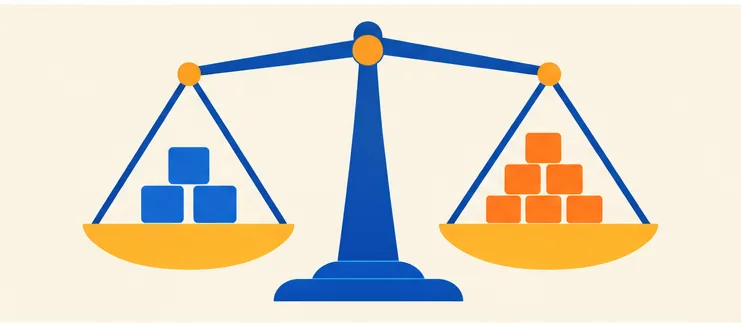
Add all the parts of the ratio.
Divide the total amount by this sum to get the value of one unit.
Multiply each part of the ratio by one unit.
Example: Divide ₹160 in the ratio 3 : 5.
Sum of parts = 8. One unit = 160 ÷ 8 = 20. Shares = 3 × 20 and 5 × 20 = ₹60 and ₹100.
Percentage to ratio: If A is 25% more than B, then A : B = 125 : 100 = 5 : 4. So B is (5 − 4)/5 = 20% less than A.
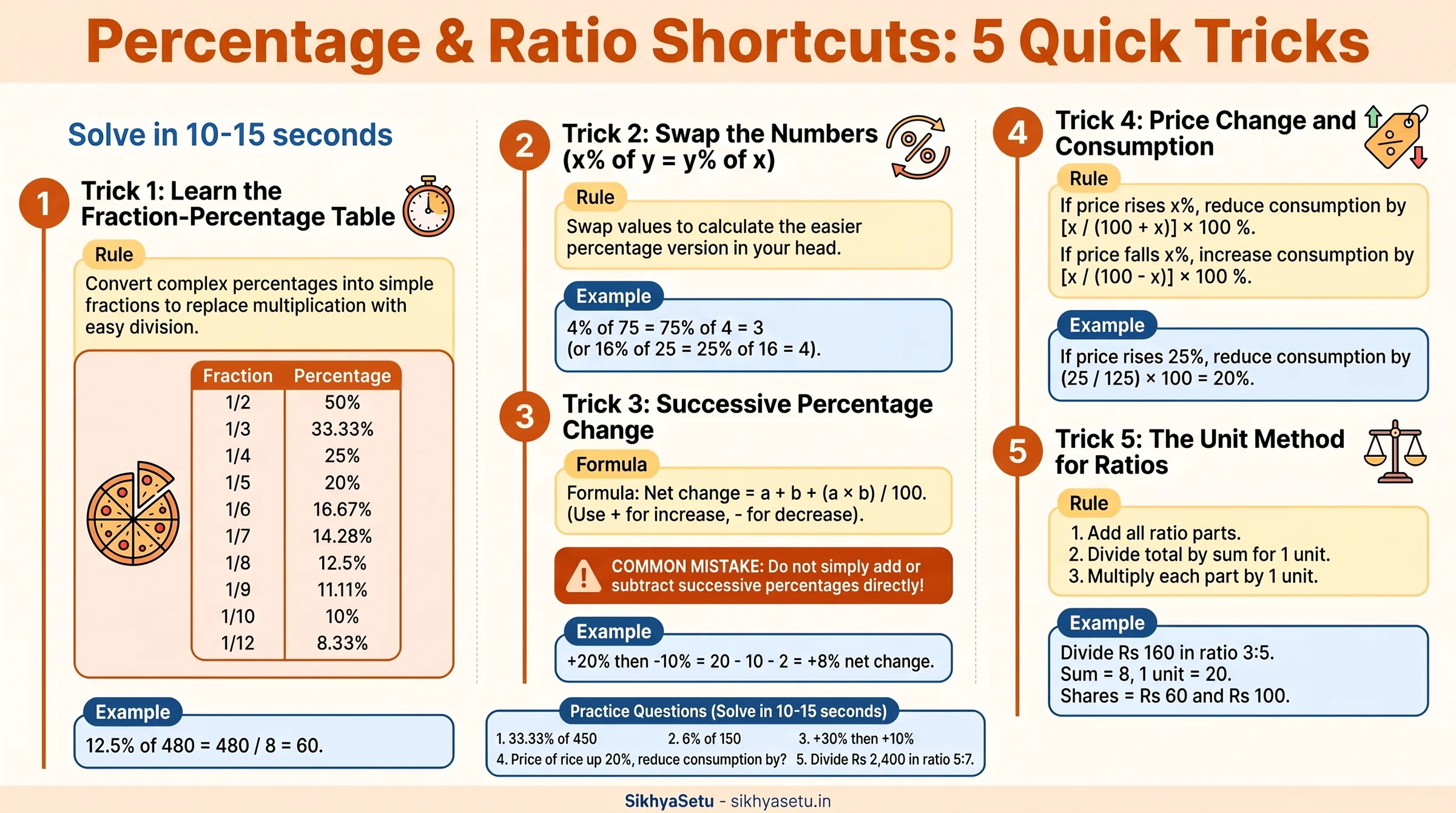
Quick revision: all 5 tricks in one picture
Practice questions
What is 33.33% of 450?
Find 6% of 150.
A price rises by 30% and then by 10%. What is the net increase?
The price of rice rises by 20%. By what percentage must a family reduce its consumption to keep spending the same?
Divide ₹2,400 between two people in the ratio 5 : 7.
Answers
150 (33.33% = 1/3, and 450 ÷ 3 = 150)
9 (6% of 150 = 150% of 6 = 9)
43% (30 + 10 + (30 × 10)/100 = 43)
16.67% (20/120 × 100 = 1/6)
₹1,000 and ₹1,400 (sum = 12, one unit = 200)
Practise these tricks with a timer. Speed comes only with repeated practice. For the exact syllabus and exam pattern, always check the official notification.